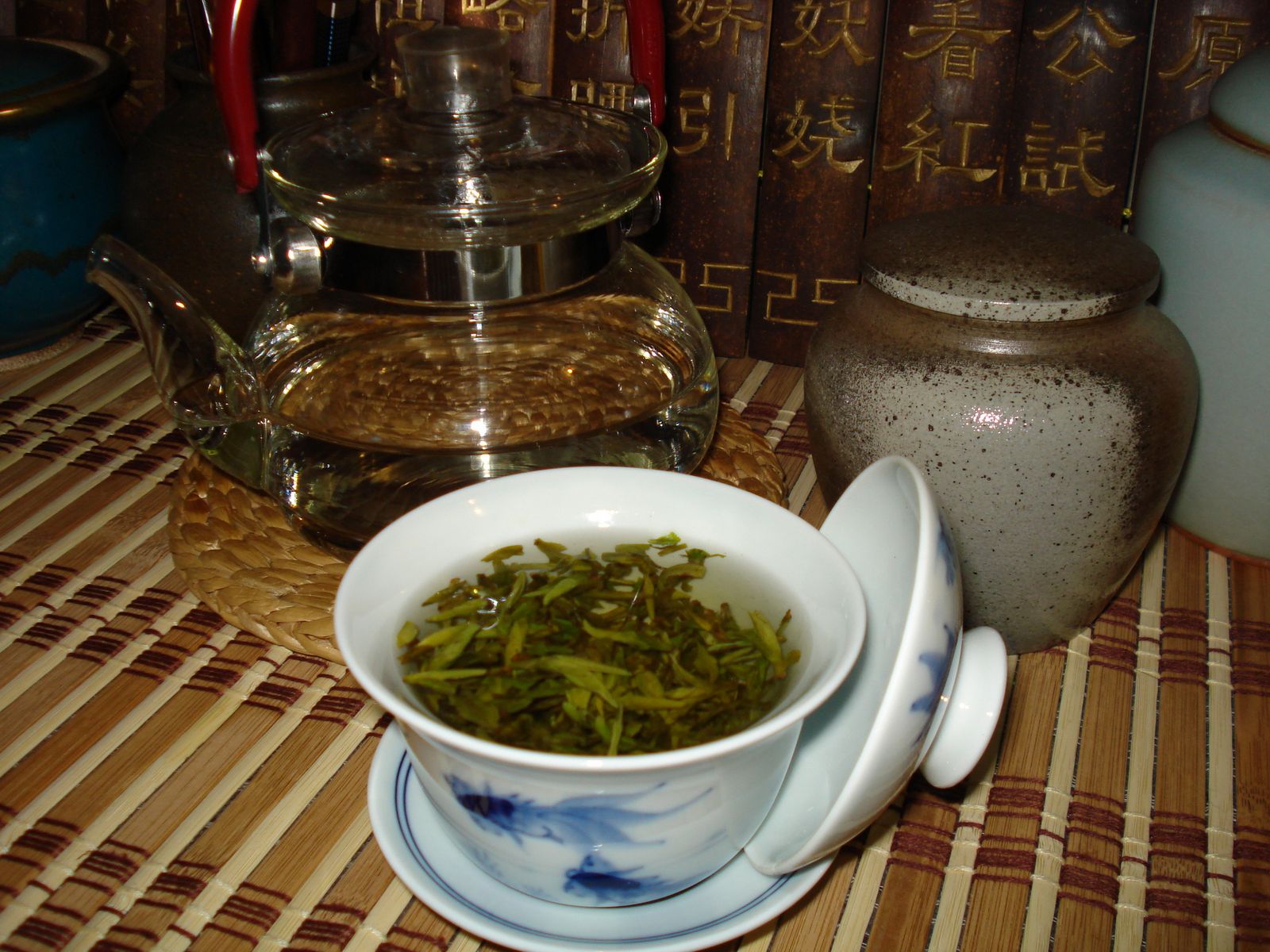
I am always in search of teas that are not your everyday sorta things that you find from any number of online stores. When I saw that Ginko was offering a handmade China green that was made by a Mom (not her Mom) it stirred up all kinds of interest in me. I picture a little Chinese woman living a quiet life, just tending her garden and once a year making her own tea. You know perfectly well a Mom is only going to pick the best leaves and see to it that every step of the drying process is done correctly. If you want anything done right, do it yourself. This Mom knows how to make some good tea.
The dry leaf is small in size but thick and chunky. Moms tea has a really pungent aroma. Almost like a Lu Shan Clouds and Mist tea but with a lot more depth. One kinda odd thing about it is that from the moment you add water to the pot the leaves immediately sink to the bottom. It's the only green tea I've seen do this. They absolutely refuse to float, even when I encourage them they stand their ground and refuse to budge.
Mom's tea is pretty much what you would expect from a Mom, unpretentious and humble but satisfying. Very full mouth feel, rich and herbal with a touch of salinity. The aftertaste is the only time I notice any sweetness. Ginko has a small quantity of this tea and is offering it at a absurdly low price. Limited to 2 packets per customer, I'm already at my limit. A really unique tea that I wish I could get more of.
Showing posts with label China Green Tea. Show all posts
May 24, 2013
May 9, 2013
Ginko's Great Buddha
I have the good fortune to be the ( very appreciative) recipient of some of Ginko's (Life In A Tea Cup) Great Buddha Dragon Well. It has been a very long time since Ive had the pleasure of a cup of pre Qing Ming Dragon Well. Ginko was kind enough to send me a few teas from her current selection. These Pre-Qing Ming teas are not available in large quantity's, they are not going to last long. So, I,m hoping everyone gets a chance to try these teas before they are sold out.
Pre-Qing Ming teas are the first leaves to emerge after the dormancy of Winter. Before the rain is what I remember it as meaning. Highly valued and sought after by tea lovers. But having said that, they are not to everybody,s liking. For some westerners the flavors are too delicate. I think of them as being teas with pristine clarity and focus.
Cute little tin isn't it? It contents are superlative. So green and vibrant. The aroma from the dry leaf is so fresh and sweet. And there is something that reminds me of pine. You can see in the picture below that the picking standard was very consistent. Practically every leaf and bud set are the same size. The dry leaf is still pliable. Not brittle and crumbly. This pliability is testament to its freshness.
My tea table is just about functionality today. No flowers or dramatic lighting. It is, what it is. The tea has been brewed with loving care and attention. Freshly heated spring water that has dropped to 175 degrees. With Pre-Qing Ming teas I try to be careful with brewing time. A gentle approach pays off.
There are a lot of people that are of the opinion that you don,t have to be all that careful brewing these Pre-Qing Ming teas. I am not one of them. It's too easy to kill the tea by water that is too hot or too lengthy an infusion time. The end result of either of these scenarios is that what should the slightest bite of astringency can easily wind up being the more dominant aspect in the cup, you don't want that.
The aroma of sugar snap peas and pine as well as some very delicate florals waft from the pot and cup. The first sips are sweet as could be. The pine or maybe I should say sap like flavors contrast with the sugar cane sweetness, a perfect balance. Typically I think of Dragon Well teas to be kinda nutty, yeasty, toasty and slightly vegetal, but this one is different, so clean and delicate.
The color of the brewed tea is actually a tad lighter than the picture below. Crystal clear with an almost silvery sheen. Pretty darned durable too boot. I get 3-4 infusions before it starts to fade. The teas aftertaste is unrelenting. It's sweetness permeates the entire mouth and even the nasal passage. It's early spring and I am usually so congested this time of year due to allergies that I cant smell a thing, but this tea seems to have helped to clear me up a little. I wonder if there is any history of tea being used as a decongestant?
Thank You Ginko! I cant wait to try the some of your other offerings. As this years teas are making their way to the states I,m keeping a close eye on Life In A Tea Cup to see what else you have in store for all of us tea lovers. The proofs in the pudding. Evidently, Ginko has some MOFO connections. Take advantage of it for crying out loud. For more information on this tea pay a visit to Ginko. She,ll hook you up!
Pre-Qing Ming teas are the first leaves to emerge after the dormancy of Winter. Before the rain is what I remember it as meaning. Highly valued and sought after by tea lovers. But having said that, they are not to everybody,s liking. For some westerners the flavors are too delicate. I think of them as being teas with pristine clarity and focus.
My tea table is just about functionality today. No flowers or dramatic lighting. It is, what it is. The tea has been brewed with loving care and attention. Freshly heated spring water that has dropped to 175 degrees. With Pre-Qing Ming teas I try to be careful with brewing time. A gentle approach pays off.
There are a lot of people that are of the opinion that you don,t have to be all that careful brewing these Pre-Qing Ming teas. I am not one of them. It's too easy to kill the tea by water that is too hot or too lengthy an infusion time. The end result of either of these scenarios is that what should the slightest bite of astringency can easily wind up being the more dominant aspect in the cup, you don't want that.
The aroma of sugar snap peas and pine as well as some very delicate florals waft from the pot and cup. The first sips are sweet as could be. The pine or maybe I should say sap like flavors contrast with the sugar cane sweetness, a perfect balance. Typically I think of Dragon Well teas to be kinda nutty, yeasty, toasty and slightly vegetal, but this one is different, so clean and delicate.
The color of the brewed tea is actually a tad lighter than the picture below. Crystal clear with an almost silvery sheen. Pretty darned durable too boot. I get 3-4 infusions before it starts to fade. The teas aftertaste is unrelenting. It's sweetness permeates the entire mouth and even the nasal passage. It's early spring and I am usually so congested this time of year due to allergies that I cant smell a thing, but this tea seems to have helped to clear me up a little. I wonder if there is any history of tea being used as a decongestant?
Thank You Ginko! I cant wait to try the some of your other offerings. As this years teas are making their way to the states I,m keeping a close eye on Life In A Tea Cup to see what else you have in store for all of us tea lovers. The proofs in the pudding. Evidently, Ginko has some MOFO connections. Take advantage of it for crying out loud. For more information on this tea pay a visit to Ginko. She,ll hook you up!
January 22, 2011
2010 Dragon Whiskers Mao Jian
He's so sleepy, he can just barely keep his peepers open. I think it's safe to assume that I can now have an un-interrupted tea break, if I,m very quiet about it. Tyson thinks he needs to be involved in everything I do. Boxers are a great breed of dog, good natured and fun. But if they have one fault, it's separation anxiety. He has to be constantly touching you, leaning against you, or worst of all, staring at you.
If I had to choose just one type of tea to drink for the rest of my life, it would undoubtedly be green tea. I generally like all types of tea but green tea is the only tea that I actually crave. From "Tea Trekker" this Mao Jian is a fairly new addition to their catalog. Bob and Mary Lou bought this tea during their recent trip to the Fang Cun Tea Market in Guangzhou China. They made the decision to add this to their catalog immediately upon tasting it, and I can see why, it's delicious! Ive become a big advocate of Tea Trekker, everything Ive had from them was excellent quality and priced fairly.
This Mao Jian is an early spring harvest tea from Zhejiang province. The Mao Jian pluck is defined as one bud and leaf. Hand rolled and pan fired. When it comes to green tea I don't bother with scales for weighing the quantity, I just get a feel for it. It's probably around 3 grams of leaf to six ounces of water. This Mao Jian needs cooler water than other China greens. I get the best results using water at about 175 degrees. Water temperature and brewing times are important factors of brewing green tea that I am fairly diligent about. Timing is everything, it's not that this tea will become bitter or astringent if the water is too hot, but you will exhaust the leaf prematurely and you won't get as many brews from it.
Be observant and pay attention when brewing green tea. Decant too soon and the brew isn't all it could have been, the flavors and aromas haven't been fully developed. Wait a little too long and the best flavors to be had are long gone and there's no way to go back and get them in the subsequent brews. You blew it! Brewing first pluck greens can be a challenge, but it's worth the effort when it comes to some farm fresh, high quality teas.
That picture up there speaks volumes about the quality and the condition of this tea. Absolutely beautiful leaf with such a healthy green color. As you can see below the brew is a crystal clear, golden color. Slightly sweet, rich and vegetal. As soon as the water hits the dry leaf there is an explosion of the most mouth watering aromas wafting from the shiboridashi. This is what good green tea is all about. And whats more is that it's not a very expensive tea.At $60.00 a lb. it's a very fair price for a tea of this quality.
Very easy to brew, I get three good infusions from the leaf. This tea infuses pretty quickly, about 1&1/2 to 2 minutes. The second infusion is almost indistinguishable from the first, no real noticeable difference in the flavor, color or the body. The third infusion is almost as good, definitely fading but still too good to let it go to waste.
Well, I almost made it through the entire session without Tyson waking up. The Postman rang the doorbell and Tyson was off and running again. Both a blessing and a curse because the Postman brought more tea.
December 4, 2010
Ding Gu Da Fang
I always feel a little guilty about having all of these teas going un-drunk and wasting away in the tea cabinet. So, Ive been making an honest effort to consume a substantial quantity of these neglected teas before Christmas gets here and I get bombarded with more gifts of tea.
Ding Gu Da Fang is a China green tea that was once a tribute tea during the Qing Dynasty and at one time was included in the list of China's 10 famous teas. Legend has it that a Buddhist monk by the name of Da Fang invented this tea during the Song Dynasty. Ding Gu translates as Valley Peak. Grown in the An Hui province.
First thing many people say about this tea is that it reminiscent of a Long Jing, "Poppycock" it's only similarity as far as I can see is that the dry leaf kinda resembles Long Jing in that it's kinda flat, thin and a yellowish green in color. It has none of the toasty, yeasty flavors that I associate with a Long Jing. The leaf in the above picture looks pretty tattered (bottom of the caddie) but you can see in the top picture that the dry leaf is for the most part whole and beautiful.
Ding Gu Da Fang tastes of chestnuts, smooth and buttery, slightly sweet and vegetal with a medium body. It's not a dainty tea by any means. Most of the descriptions Ive read about Ding Gu Da Fang tea always refers to it as being rather strong tasting, Ive never thought of it as strong. Ive also never had a Ding Gu Da Fang that was anything more than a really good everyday type of tea, just a rich and tasty cup that wouldn't hurt any ones budget. For my tastes this tea requires extra leaf to get fully saturated flavors, I typically use about 3&1/2 gms. per 6 oz. 185 degree water, with a 2-3 minute infusion time. Ive had a kilo of this tea in the cabinet since last spring and though I drink it almost daily Ive got a long ways to go before it's gone. For anyone interested in trying this tea "Uptons" has just re-stocked it (which is where I had bought this batch) and it's affordable too boot!
The only reason for the above picture is just because I like the cup, but it's not mine. I got it for a friend and it's on it's way to Canada. Oh well......we bonded a little, we laughed, we cried, but now it's time for you to go. The cups as well as the shiboridashi in this post were made by Petr Novak. The shiboridashi has some issues, the glaze is chipping off all around the edge of the lid. But I don't know why, it's never been treated roughly. Perhaps Petr can tell us why the glaze is crumbling?
July 21, 2010
Tea Trekker Greens Pt. 2 "Lu'An Gua Pian"
I touched upon the topic of the seasons dictating my choice in teas in the previous post. To continue with this issue, I pretty much only drink green teas during the Spring and Summer months. Yancha or Dan Congs are also on the menu from time to time. Listening to that little voice in my head, I comply and save the Puerhs and Taiwan Oolongs for Autumn and Winter. For me that's when the time is right for such robust and intense teas. So.......there isn't going to be much talk of sheng on Tea Goober for a while, unless I run across something worth mentioning, the "Boys Club" (sheng posts) will be on hold.
" Lu'An Gua Pian "
China produces thousands of different kinds of green teas but there are really only a handful that I,m interested in. Without doubt one of my favorite China green teas. Lu'An Gua Pian is grown on Lu'An mountain in the Anhui Province. From what Ive read it is by far one of the most difficult China greens to produce. One of the reasons for the difficulty is the picking standard, only the first true leaf below the bud set is used to make Lu'An tea. Then the leaf is de-veined, can you imagine having to remove the vein from each and every leaf? Multiple basket firings finish the tea. This particular batch is from 2009, getting to be quite elderly but still delicious.Tea Trekker has become my "go-to" guys for China green teas.
Lu'An tea leaves are always big, thick and chunky. Colors ranging from a light olive to the deepest of greens. There is a lot of depth in the dry leafs aroma yet it subtly hints at the flavors to come. Even with it's age I can still smell the sweet and earthy characteristics that I remember from it's youth. Lu'An Gua Pian always brews a cup that's full, round and rich. Brews a cup that's deep golden yellow in color with the slightest of green undertone. Ive found Lu'An tea always good for several infusions. If you have tried China greens and thought them to be not your cup, Lu'An might be the tea that changes your mind. It's very different from any other China green tea. Lu'An has no astringency what so ever and never turns bitter from over steeping. You can see the depth of color in the cup, it's not a light and wimpy tea at all. Almost Oolong like in it's viscosity but most definitely a green tea flavor profile.
Next in line is some Lu'Shan Clouds & Mist and Purple Bamboo. Good stuff !
Something unrelated !
Another of Tysons morning rituals, he will whine and whine until Ive made the bed. He literally wants the bed made so that he can then re-make it just the way he wants it. He's such a turd sometimes. Now that he has all the pillows just the way he likes em, (everything wadded up in a pile) he wants me to go away and leave him alone so he can take a nap. Nighty nite Tyson.
July 13, 2010
Tea Trekker Greens
With the unrelenting summer heat beating down, my taste in teas change. Heartier teas like Puerh and most Oolongs are not at the top of my list, they get relegated to the Autumn and Winter months. They are just too heavy, too much for me. I want something clean and refreshing, yet something rich and satisfying at the same time. Ive some China Greens that fit the bill very nicely. Both from Tea Trekker. And both of them superb examples of high quality, handmade greens that are sold at a fair price. Fair market value is my criteria when lurking for new vendors. If I find anything being sold at inflated prices on a vendors site I tend to not buy anything at all from them. Tea Trekker is an online vendor that I,ll return to again and again. Superlatives without the grief of an empty wallet.
First up is an excellent China green. A 2010 Pre-Qing Ming Gan Lu, or "Sweet Dew" Gan Lu is a tea with a lot of character and a very long history. An early Spring tea that was an Imperial favorite during the Tang Dynasty (960-1279) Grown on Mengding Mountain in the Sichuan Province. Opening the bag fills the room with rich vegetal sweetness. Just the smell of the dry leaf alone makes my mouth water. Comprised primarily of a bud only picking that is covered in silvery, fuzzy down. Soft and velvety to the touch. Vegetal without the raw spinachy tastes of other greens. I love those veggie teas but that veggieness has to be balanced with other flavors and aromas. This tea is buttery smooth with no bitterness or astringency. Even the most negligent of brewers will have no problem with this tea, never becomes bitter when over steeped or when using hotter than necessary water. Durability is good, 2-3 infusions. Brews up a sparkling clean cup of golden, silvery tea. Absolutely delicious.

Next up, Lu'An Gua Pian and 2010 Pre-Qing Ming Man Tang Xiang.
Gan Lu
Long Ding
Next up is an equally excellent 2010 Pre-Qing Ming Long Ding from Zhejiang Province. Long Ding is a early season, pan fired tea that's made from a bud only picking standard. This being a "Larks Tongue" style of tea it's best appreciated brewed in a glass pot or cup. The leaves are juicy, plump and intensely green. Long Ding is one of those teas that infuse vertically, the leaves tend to stand on end while brewing. The dry leafs aroma is intensely pungent, reminds me of walking through a pine forest in the Autumn. The teas flavor is slightly vegetal, very crisp with a touch of pine. I suspect that the soil this tea is grown in is very rich in minerals, rocky and flinty soils show up as cleanliness in the cup, at least that's my theory. Delicately sweet and clear as a bell. Very crisp, bright and refreshing, yet at the same time fairly rich. Brewing parameters do need to be adhered to in order to not over steep this tea. It will become bitter if left too long in the pot. What a gorgeous tea! Durability is very good, 3-4 infusions.
Next up, Lu'An Gua Pian and 2010 Pre-Qing Ming Man Tang Xiang.
May 21, 2010
2010 Pre-Qing Ming Dafo Long Jing
Tis the season for what is one of my all time favorite Chinese green tea's, Long Jing a.k.a. Dragon Well. Even those unfamiliar with green tea's are likely to have heard of Long Jing. There is no other tea on earth that smells as good as Long Jing, at least in my opinion. A lb. of this Dafo Long Jing was delivered just a few days ago (I know...a whole lb?) I had some steeping in a gaiwan in the kitchen and while side tracked in another room the rich and nutty aroma that is unique to Long Jing wafted down the hall to remind me that it was ready. The aroma is very intense and it permeates the entire room but this tea is way too expensive for such negligent brewing. In the summer months I,m all about fresh and clean green tea's. Oolong's and Puerhs are for the most part relegated to Autumn and Winter, they can be just a little too heavy in hot weather.
This "Dafo" Long Jing is not grown in the officially designated county of Xi Hu, but just outside of it, in Xin Chang county. Tea's grown in Xi Hu county are the cream of the crop Long Jing's. But of course there are different grades of tea from Xi Hu and I would rather pay for a prime grade from a lesser esteemed region than a lower grade from the primo region. People that are interested in pinching pennies yet still want a high quality tea have been appreciating Dafo Long Jing for years. Usually about half the price of the tea's grown in Xi Hu. The designation of "Pre Qing Ming" means that it was picked before the rains. The very first pick of the year is the one that is most prized. As you can see in the pics the dry leaf is well made, almost paper thin bud and leaf sets that were pan dried, the old fashioned traditional way, by hand in large wok's.
I think that green tea's are the hardest of all tea's to brew well. The slightest change in brewing parameters can yield very different tastes and aroma's. The skill required to brew these tea's to perfection every time is not a skill that I claim to have mastered but sometimes when everything is just right, water temp. infusion times and all the other variables are in sinc it's easy to realize why this tea is so famous. It's simply some of the best tea there is. This particular Long Jing requires a very specific water temperature of 185-187 degree's. Water either hotter or colder and the tea's aromas will not bloom nearly as well. Also needs a little more leaf than tea's from previous years. Growing conditions were not good this year and it shows in a lot of the tea's on the market. The Pre-Qing Ming Long Jings will brew a more light and delicate cup than the all leaf Long Jings. But don't confuse light and delicate with weak and thin. These Qing Ming tea's flavors are much more focused and complex. Each of the tea's flavor componants are apparent, they don't become muddled and blunt. The world is full of thousands of supposed Long Jing's and most of them aren't even from Zhejiang province. But if you buy from vendors that know their stuff and you are willing to pay for it, finding the real thing isn't that much of a challenge. But having said that, the only Long Jing that we are ever going to see is what is available commercially. I don't think we are ever going to taste the cream of the crop by shopping online. But that's o.k. by me, as long as I can continue to get tea's of this quality then I,m a happy camper.
Subscribe to:
Posts (Atom)